

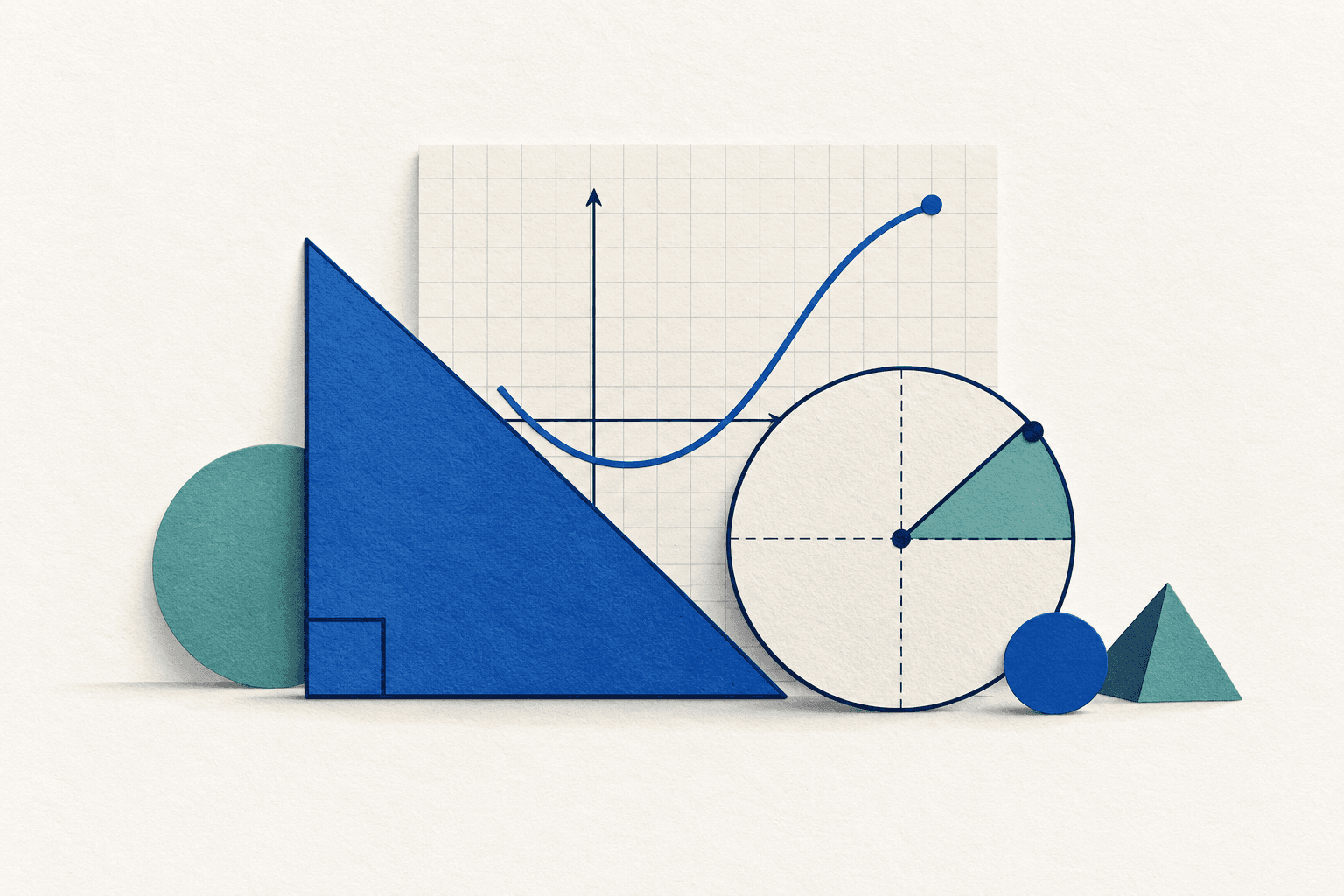
In a right-angled triangle, trigonometric ratios connect an acute angle with ratios of side lengths. Name the sides relative to the angle you are using. The opposite and adjacent sides change when you choose the other acute angle, but the hypotenuse stays opposite the right angle.
The three main ratios
For an acute angle θ, sin θ = opposite/hypotenuse, cos θ = adjacent/hypotenuse and tan θ = opposite/adjacent. The hypotenuse is the longest side. Scale a triangle up or down without changing its angles, and these ratios remain unchanged.
The identity sin² θ + cos² θ = 1 is useful for simplifying expressions and checking calculations. Also tan θ = sin θ/cos θ whenever cos θ is non-zero.
- At 30°: sin = 1/2, cos = √3/2, tan = 1/√3.
- At 45°: sin = cos = 1/√2 and tan = 1.
- At 60°: sin = √3/2, cos = 1/2, tan = √3.
Draw before calculating
For a heights-and-distances problem, draw the ground, the vertical object and the line of sight. Mark the angle at the observer. Choose the ratio that uses the given side and the unknown side.
If the angle is measured from an observer’s eye above the ground, the triangle gives the height above eye level. Add the observer’s eye height when the question asks for the object’s full height.
Put it into practice
A worked example
A vertical pole casts a 12 m shadow on level ground. The Sun’s angle of elevation is 45°. Find its height.
- Use tan 45° = height/shadow length.
- Since tan 45° = 1, height/12 = 1.
Answer: The pole is 12 m tall.
Try it yourself
Have a go before revealing the answer.
An acute angle has opposite side 3 and hypotenuse 5. Find sin θ and cos θ.
Show answer
sin θ = 3/5. The remaining side is 4 by Pythagoras, so cos θ = 4/5.
Answer: sin θ = 3/5. The remaining side is 4 by Pythagoras, so cos θ = 4/5.
Evaluate sin² 30° + cos² 30°.
Show answer
1/4 + 3/4 = 1.
Answer: 1/4 + 3/4 = 1.
Watch out for these
- The angle of elevation is measured from a horizontal line.
- Do not use a memorised ratio until the sides are labelled for the correct angle.
Continue with official resources
Match these concept notes to your current textbook and syllabus. They are independent explanations, not official board publications.